Turnip
http://www.100md.com
《e Natural Health Center》
 |
 |
 |
 |
Vegetables
Turnip
Latin:
Brassica rapa
Origin:
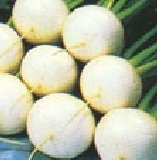
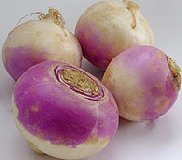
Turnip is a hardy biennial root vegetable Brassica rapa L., of the Cruciferae family, about the size of a small apple. Turnip consists of a great variety of species, the most common ones with a firm ivory skin that has a blush of purple on the shoulders, but there are also those with red skin, green skin with red flesh (called xinlimei in northern China), long shape, oval shape, etc. However, their therapeutic usage is basically the same.
, 百拇医药
Turnips are sturdy growers in cold climates and one of the oldest vegetables known. Early humans wrapped turnips with wild onions and then in leaves and roasted them over the fire. The true turnip probably originated in middle and eastern Asia and by cultivation has spread throughout the temperate zone. It is extensively cultivated, often as a cattle fodder crop, in Canada, Great Britain, and northern Europe and to a lesser extent in the United States. It is also grown in China, Japan, Iraq, Kurdistan, etc.
, 百拇医药
The biennial plant grows to about 0.5 m tall. It is in flower from May to August, and the seeds ripen from July to September. The flowers are hermaphrodite (have both male and female organs) and are pollinated by bees. The plant is self-fertile. It can grow in semi-shade (light woodland) or no shade, and requires moist soil.
Turnips are available year-round, but the best ones come to market in the fall.
Also called Birdrape, Rape, Rape Mustard, Mustard Spinach, Shelem, etc.
, 百拇医药
Properties:
Sweet, bitter and pungent in flavor, slightly cool in nature.
Functions:
Improves appetite, pushes qi downward, benefits dampness, counteracts toxic effects.
Turnip is a very popular medicinal food. Usual consumption is very likely to bring good health. Hence, the old saying: When turnip appears in the market the doctor is doomed to return home, and "Eat turnip in winter and ginger in summer, there's no need to trouble a doctor"; hence, the nickname "junior ginseng in the winter" for the turnip among the masses.
, http://www.100md.com
Applications:
Turnip is usually applied in poor digestion, dispelling heat phlegm, chronic bronchitis, hoarseness, jaundice, diabetes, swelling with hot sensation, boils, mastitis and bleeding. Extracts from the turnip tuber, root, as well as seeds, reveal antibacterial action. It also yields detoxified actions.
1. To treat abdominal flatulence or coughing with profuse phlegm:
, 百拇医药 Prepare 100-200 g turnip and squeeze to obtain juice. Add 50 g rock sugar and serve it before bedtime for 3-5 successive nights.
Case example: An old man of 54 had flatulence and belching for 1 year. He felt indigestion and had been prescribed biofermin 2 g three times a day. He received the treatment for a period of two months to no avail. He then was advised to use the first above-mentioned recipe. His condition was markedly alleviated 2 months later and totally cured in a period of 3 months.
, 百拇医药
2. For chronic bronchitis:
Use 200 g turnip with red skin. Cut into small pieces and put in a bowl on which 2-3 tablespoonfuls maltose are added. Let stand for a whole night. Drink the juice thus formed as one likes.
3. For uterine bleeding and other bleeding:
Wash 1,000-2,000 g turnip and cut into small pieces. Squeeze to obtain 250-300 ml juice. Add 30 g sugar and divide into 2 doses. Consume in a single day.
, 百拇医药
Dosage and Administration:
Young turnip roots are eaten raw in salads or pickled. The roots are also cooked and served whole or mashed and are used in stews. Often used as a cooked vegetable, the young roots can also be grated and eaten in salads, they have a slightly hot flavor like a mild radish.
Scrub turnips with a vegetable brush before cooking. Then trim the leaf end and slice off the root end. Larger turnips should be peeled, but baby turnips--those less than 5 cm in diameter--can be cooked without peeling. Thinly sliced turnips have a crisp texture, and can be consumed raw.
, 百拇医药
To boil: Cut turnips into chunks and boil until they are tender, about 6 to 10 minutes. Whole turnips take about 30 minutes to cook.
To roast: Use either whole, unpeeled baby turnips or larger ones, peeled and cut into wedges. Then toss with olive oil, salt, and pepper, and place them on a baking sheet in a single layer. Roast at 190° C until they are tender, about 35 to 45 minutes.
To microwave: Place turnip cubes, with a few tablespoons (30 to 45 ml) of water or stock in a covered microwave-safe casserole and cook on High for about 3 minutes. Then let stand for about 3 minutes before serving.
, http://www.100md.com
Good flavors for seasoning turnips include lemon, nutmeg, garlic, cheeses, thyme, parsley, and chervil.
The young leaves may be served raw or cooked. The cooked leaves make an acceptable vegetable, though they are coarser than the related cabbage. They are more often used as a spring greens, sowing the plants in the autumn and allowing them over winter. Young leaves can also be added in small quantities to salads, they have a slightly hot cabbage-like flavor and some people find them indigestible.
, 百拇医药
The tuber root and seeds are all used for medicinal purposes; the red skin and white skin species are most commonly used.
Since larger roots can have a more woody texture, look for small turnips. Smaller turnips also have a sweeter flavor. They should be smooth-skinned and without blemishes. Store them in a perforated plastic bag in the refrigerator crisper, and use within a week or so.
Cautions on Use:
, http://www.100md.com
Though turnip gets a nickname "junior ginseng", it is advisable not to use it together with ginseng.
The crushed ripe seeds are used as a poultice on burns. Some caution should be exercised here since the seed of most brassicas is rubefacient, causing redness of the skin.
Reference Materials:
Toxic or Side Effects:
Modern Researches:
, 百拇医药
The tuber root contains affluent water with glucose, sucrose and fructose. In addition, there are also caffeic acid, ferulic acid, benzo-pyruvic acid and many kinds of amino acids, as well as protein, fat, fibre, ash, calcium, phosphorus, iron, thiamine, riboflavin, and vitamin C.
In the seeds are volatile oil, fatty acid, raphanusin, protein, fat, carbohydrate, fibre, iron, thiamine, and riboflavin.
The leaves contain protein, fat, carbohydrate, fibre, ash, calcium, phosphorus, iron, potassium, thiamine, riboflavin, niacin, and vitamin C.
, http://www.100md.com
A decoction of the leaves or stems is used in the treatment of cancer.
The crushed ripe seeds are used as a poultice on burns.
Turnip root peelings contain a natural insecticide. The chopped roots can be brewed into a tea with flaked soap, this is then strained before use. It is effective against aphids, red spider mites and flies., 百拇医药