Pinellia Tuber
http://www.100md.com
《e Natural Health Center》
 |
 |
 |
Herbs for Clearing Phlegm
Pinellia Tuber
Latin:
Rhizoma Pinelliae
Origin:
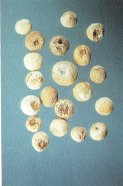
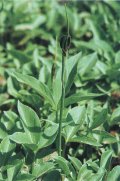
The rhizome of Pinellia ternata (Thunb.) Makino., or Pinellia tubifera (Ten.), a perennial plant, of the family Araceae. Native to east Asia, it is grown in cultivated fields, roadsides, shady and damp grass thickets on mountain sides and stream edges in China, Japan and Korea.
, http://www.100md.com
The plant grows to about 0.2 m by 0.15 m. It is in flower from July to August. The flowers are hermaphrodite (have both male and female organs). The plant can grow in semi-shade (light woodland) or no shade. It requires moist soil.
In China, pinellia is distributed in most areas but mainly in the provinces Sichuan, Hubei, Jiangsu, Anhui, etc. Harvested when the stem leaves are luxuriant in summer and autumn, the skin and fibrous roots are removed from the rhizome and then the rhizome is dried in the sun for use.
, 百拇医药
Properties:
Pungent in flavor, warm and toxic in nature, it is related to the spleen, stomach and lung channels.
Functions:
Removes dampness to reduce phlegm, lowers the adverse flow of qi to arrest vomiting and disintegrates and removes masses. For external use, it subdues swelling and kills pain.
Applications:
, http://www.100md.com
1. Treats damp-phlegm and cold-phlegm syndromes:
Drying with its pungent taste and warm nature, this is a major herb for the removal of dampness to reduce phlegm and for the warming and
resolution of cold phlegm. It is especially good at treating damp-phlegm syndromes in the zang-organs and fu-organs.
a) Coughing and dyspnea (difficult or labored breathing) with profuse and viscid phlegm due to accumulation of phlegm-dampness in the lungs:
, 百拇医药
This herb is often used in combination with tangerine pericarp, e.g., Er Chen Tang.
b) Dizziness due to damp-phlegm:
This herb is used in combination with elevated gastrodia tuber (Rhizoma Gastrodiae) and largehead atractylodes rhizome (Rhizoma Atractylodis Macrocephalae), e.g., Banxia Baishu Tianma Tang, in order to resolve phlegm and calm endopathic wind.
c) Aural vertigo (dizziness or an illusion of movement caused by the ear--aural):
, http://www.100md.com
In recent years, it has been effective in clinically treating aural vertigo with a phlegm-resolving and resuscitation-inducing preparation (composed of pinellia tuber, largehead atractylodes rhizome (Rhizoma Atractylodis Macrocephalae), raw jack-in-the-pulpit (Rhizoma Arisaematis), oriental water plantain rhizome (Rhizoma Alismatis), herb sweetflag rhizome (Rhizoma Acari Calami), cassia twig and chrysanthemum) with pinellia tuber as the principal ingredient.
d) Restlessness in sleeping due to excessive damp phlegm in the interior and disorder of stomach-qi:
, http://www.100md.com
This herb is used in combination with husked sorghum in order to resolve phlegm, regulate the stomach and calm the mind.
2. Treating vomiting due to adverse rising of stomach-qi:
Pinellia tuber is an antiemetic, which can be used in combination with other herbs according to the case for the treatment of vomiting for various causes and it is especially applicable to vomiting due to fluid retention or cold stomach.
, 百拇医药
a) Vomiting due to adverse rising of the stomach-qi:
This herb is often used in combination with ginger, e.g., Xiao Banxia Tang.
b) Vomiting due to stomach-heat:
It is used in combination with Chinese goldthread rhizome (Rhizoma Coptidis).
c) Vomiting due to deficiency of yin in the stomach:
The herb is used in combination with noble dendrobium stem (Herba Dendrobii) and ophiopogon root.
, http://www.100md.com
d) Vomiting due to deficiency of qi in the stomach:
This herb is used in combination with ginseng and white honey, e.g., Da Banxia Tang.
3. Treats epigastric fullness, accumulation of pathogens in the chest, globus hystericus, etc.:
Being so pungent as to be opening, pinellia tuber can dissipate masses, resolve phlegm and relieve the sensation of fullness.
a) Epigastric fullness with obstruction by damp-heat:
, 百拇医药
The herb is used in combination with dried ginger, Chinese goldthread rhizome (Rhizoma Coptidis) and skullcap root (Radix Scutellariae), e.g., Banxia Xiexin Tang, in order to ventilate fullness and resolve masses with its bitter and pungent tastes and clearing and lowering properties.
b) Accumulation of phlegm-heat in the chest:
This herb is used in combination with Mongolian snakegourd (Fructus Trichosanthis) and Chinese goldthread rhizome (Rhizoma Coptidis), e.g., Xiao Xianxiong Tang.
, http://www.100md.com
c) Globus hystericus with stagnation of qi and retention of phlegm:
This herb is used in combination with purple perilla, official magnolia bark (Cortex Magnoliae Officinalis), tuckahoe (Poria Cocos), etc., e.g., Banxia Houpu Tang, in order to activate the flow of qi, alleviate mental depression, resolve phlegm and dissolve masses.
4. Treats goiter, subcutaneous nodules, carbuncles, cellulitis and pyogenic infections, snake bite, etc.:
, 百拇医药
This herb can remove phlegm and resolve masses if taken orally and subdue swelling and kill pain if used externally.
a) Goiter and subcutaneous nodules:
This herb is used in combination with kombu (Thallus Laminariae seu Eckloniae), kelp, fritillary bulb (Bulbus Fritillariae Thunbergii), etc.
b) Carbuncles and cellulitis on the back, innominate inflammatory swelling and snake bite:
, 百拇医药
The raw herb is ground into powder and mixed with a fluid or the fresh herb is mashed for external application.
5. Miscellaneous:
In modern times, it has been effective to use this herb clinically when raw by grinding it into powder and applying it locally for the treatment of cervical erosion. It has also been used in combination with jack-in-the-pulpit (Rhizoma Arisaematis) in equal amounts when raw by grinding them into powder to be made into pills for the treatment of coronary disease, which has produced certain effects on the remission of angina pectoris.
, 百拇医药
It has also been ground together with herb sweetflag rhizome (Rhizoma Acari Calami) into powder for blowing into the nose to induce sneezing for the treatment of supraventricular tachycardia. In addition, raw pinellia tuber has also been used in combination with other herbs for the treatment of tumours, etc.
Dosage and Administration:
5-10 g.
Decoct for oral administration.
, 百拇医药
In general, it should be used after being prepared. Prepared pinellia tuber includes a decoction of pinellia tuber with ginger added and prepared pinellia tuber. The decoction of pinellia tuber with ginger added is good at lowering the adverse flow of qi and arresting vomiting. Prepared pinellia tuber is good at removing dampness, but its warm nature is weaker.
Pinellia tuber fermented mass can resolve phlegm and promote digestion. Turning from warm into cold in nature, pinellia with tuber bamboo juice added can clear and remove heat-phlegm and it is indicated for heat-phlegm and wind-phlegm syndromes.
, 百拇医药
Use an adequate amount externally.
Cautions on Use:
The herb is against common monkshood rhizome (Rhizoma Aconiti). Being warm and dry in nature, it should generally be used with care for dry coughing due to yin deficiency, blood troubles, heat-phlegm and dry-phlegm syndromes. However, it can also be used for heat-phlegm syndrome in combination with other herbs.
The calcium oxylate the plant contains is toxic and if consumed makes the mouth and digestive tract feel as though hundreds of needles are being stuck into it. However, calcium oxylate is easily destroyed by thoroughly cooking or drying the plant.
, http://www.100md.com
Reference Materials:
'Other Medical Records of Famous Physicians' :
"Accumulation of phlegm-heat in the chest, hypochondria, epigastrium and abdomen, coughing with adverse rising of qi, acute epigastric pain, hard masses, vomiting and regurgitation due to epidemic infectious diseases."
'The Revelation of Medicine' :
"Cold-phlegm syndrome and coughing due to impairment of the lungs by body coldness and cold drinks. Headache due to phlegm syncope in the taiyin channel cannot be relieved without this herb."
, 百拇医药
Toxic or Side Effects:
The plant is toxic.
The calcium oxylate the plant contains is toxic and if consumed makes the mouth and digestive tract feel as though hundreds of needles are being stuck into it. However, calcium oxylate is easily destroyed by thoroughly cooking or drying the plant.
Modern Researches:
This herb contains B-sitosterol, glucoside, a variety of amino acids and volatile oils, saponins, pungent alcohols, such alkaloids as choline, L-ephedrine, a small amount of fat, starch, etc.
, 百拇医药
This herb can tranquilize the cough centre, relieve bronchial spasms and reduce secretion of the bronchus to produce antitussive (suppressing cough) and expectorant (promoting the ejection, by spitting, of mucus or other fluids from the lungs and trachea effects. It can inhibit the vomiting centre to such an extent as to arrest vomiting. The derivatives of the glucoronic acid contained have an obvious antidotal effect.
Pinellia tuber also strengthens the spleen. Modern research has shown that this remedy is very effective in controlling nausea and vomiting.
, http://www.100md.com
It is also an ingredient of a Chinese prescription for removing gallstones without surgery, a process that usually causes severe nausea.
The fresh root is extremely acrid and contains toxins, these are neutralized upon drying or by soaking in tea or vinegar. The root should not be used fresh.
Extracts of the plant have been shown to have analgesic (insensibility to pain), antiemetic, anticancer and sedative activity., 百拇医药